During the AD 19th century, the stove industry experienced many advancements. Whereas blast furnaces smelted iron ore and were near iron ore sources, the cupola furnace technology came over from England, which was used to reheat pig/crude iron and scrap, this enabled foundries to be further away from iron ore sources, and the cast product could become specialized. Stove manufacture became a specialty. The introduction of the flask for moulds enabled manufacturers to cast thinner stove parts, and parts that were curved. Firewood continued to be used in homes as a fuel throughout the century, but coal displaced firewood in many homes. Jordan Mott's inventions (late 1830s) created stoves that made use of the smaller sizes of coal that at the time were considered waste. Around the mid-19th century, central furnaces were introduced and new home builds began to incorporate these to have the luxury of central heating. Prior to central furnaces, cookstoves contributed to the home heating but parlor stoves were the main heat generators for elsewhere in the house. Later, central boilers with steam heat and radiators were available, as well as inventions for parlor stoves designed to burn hard coal, particularly baseburners, made stoves ever more efficient at extracting as much heat from the exhaust as possible. Near the end of the 19th century, circulator type parlor stoves began to be produced, these had a utilitarian stove with a decorative outer shell; central hot air furnaces had always been a sort of circulator stove, but circulator stoves were marketed in place of parlor stoves.
Iron cooking ranges for open coal fires were already in use in the late 18th century Britain. These ranges were fixtures to the kitchen, and already had many of the important features, such as water reservoirs, trivets, and cast iron ovens, that would continue to be manufactured in 19th century solid fuel closed combustion cooking ranges.
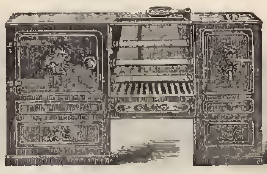
This illustration of an open coal burning kitchen range comes from a Benham & Sons (London) 1868 catalog. This range likely would be set into the hearth and bricked in on the sides. Note the oven on the left side, the boiler on the right side, and the swing out trivet on the top. The center grate area is the coal bin.
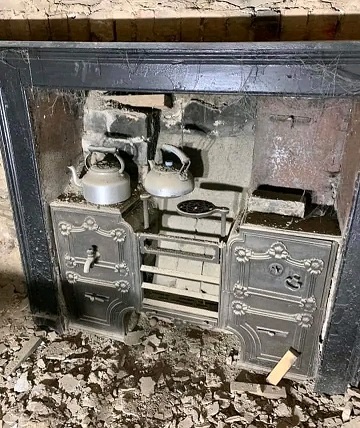
In this image, the open coal range has a water reservoir to the left with a spigot, two trivets for use above the fire in the center grate, and ovens to the right.
You can see a photo of an open range with a fire posted by ALAMO2008@flickr.
Benjamin Thompson (aka Count Rumford), in the last decade of the 18th century, is attributed as the inventor of the closed combustion cooking range, which was a fireplace with closed brick fireboxes and fitted with an iron oven, each firebox had a iron cover with a round hole that pots could be set in to cook over that fire. Thompson's ranges were constructed for large organizations and not made for home use, but control of the fire and fuel efficiency of a closed combustion range were demonstrated. In contrast to the open coal burning range examples above, and Thompson's closed combustion cooking ranges that were in part masonry and attached to the chimney, the 19th century saw cookstoves and ranges for firewood and coal become all cast iron (not fixed), these were sometimes referred to as a 'portable'. Much of the 19th century advancements of the cookstoves and ranges were in the layout and arrangements of its features, especially in where the firebox was in relation to the ovens and rounds, and how the internal exhaust was routed through the appliance to the exhaust/exit port.
The primary advantage that a stove offers (including closed combustion ranges), as opposed to an open fireplace, is that it can resist the room air from reaching the fire, if the stove is sized to the room it is tasked to heat then the stove is able to heat at a faster rate than the room air is chilled by colder objects, such as a window pane. Solid fuel stoves have control(s) to manage air intake that supplies the combustion needs of the fire, the fires only need a small amount of room air to maintain combustion; the combustion air taken in by the stove must be replaced by outside air entering the house, but due to the small volume of replacement air that is drawn in- it has little cooling affect on the interior space. Controlling the temperature in the heated room becomes a matter of feeding the fire the appropriate amount of fuel and adjusting the air controls for the desired rate of burn.
Regarding stove, like one aspect of modified open fireplaces, people often think that heating with a stove will be even more efficient by ducting outside air directly to the stove's air intake, and in principle it is, though in practice the ability to manage the fire suffers from having much colder combustion air supplied to it. It is seen among modified open fireplaces from published plans of those designs that have matured through multiple revisions, that a longer duct of outside air has been added so that the supplied outside air gets warmed somewhat either by the masonry of the chimney or by the floor of the room the fireplace is in before being released in front of the fire. Similarly, modern stoves that have collars for outside air ducts to be attached usually situate the collar away from the intake control and include an integrated duct so the supply air is heated first by the side of stove before being admitted to the fire.