Consider what is happening to firewood that is on fire, in an open fireplace. As wood heats up, its moisture content evaporates, and volatile compounds begin to gasify; this process is known as 'distillation'. There are many different compounds each with their own properties. If the heat is intense enough to reach the flashpoint for a particular volatile compound then those will ignite, usually in the presence of oxygen, just above the firewood. The volatile compounds that don't ignite continue to be carried away from the fire as part of the exhaust. As the volatile compounds gasify they leave behind the carbon structure of the firewood, called charcoal. As the carbon of the charcoal burns away, it leaves behind ash, which are particles that will not vaporize at those temperatures and / or are not combustible. You can find literature that explain all the compounds that have been identified in most woods, and better respresent the stages of combustion that firewood goes through. What is of interest here is that during an open fire, surrounding air is quickly heated by the fire and carried away with the exhaust; this creates a vacuum, which draws in more surrounding air, that in turn is heated by the fire and is carried up with the exhaust; though the fire is hot, much of the generated energy is being absorbed by surrounding air that travels upward with the exhaust.
Where does the heat of an open fire go? Assuming it is a fire in a fireplace in a house, part of what it heats is what has already been mentioned, through convection, the air adjacent to the fire, that escapes up the chimney. If you were able to stand close enough to the fire, you might feel that heated air, but you would likely smell the exhaust fumes too. Some energy is probably conducting from the edges of the firewood and ashes that is resting on the hearth into the masonry of the fireplace. The remaining comes out in the form of infrared radiation, heating whatever it strikes, this is the energy that people warm themselves with when standing near a fire.
"That branch of domestic economy devoted to the preparation of food, has not till the time of Count Rumford, been considered in a scientific point of view. Nothing can be more preposterous and unappropriate than the prevailing construction and management of a gentleman's kitchen. Before the discovery of the stew hearth, all the culinary processes were carried on with one immense open grate, burning as much fuel in one day as might do the same work for ten. The cook and the furniture of the kitchen get a proportion of this heat, the articles to be dressed another portion, but by far the greatest quantity goes up the chimney." -- from The Philosophy of Domestic Economy; As Exemplified In The Mode Of Warming, Ventilating, Washing, Drying, & Cooking, And In Various Arrangements Contributing To The Comfort And Convenience Of Domestic Life | by Charles Sylvester, Engineer | 1819 | page 10
The reference here to "burning as much fuel in one day as might do the same work for ten" is probably a contrast to a later wood burning appliance that the writer would have been familiar with.
In the decade of the 1830s, roughly 2,000 Detroiters burned 200,000 cords of wood in their hearths a year. -- from the article from The Detroit News, titled "When stoves were the hot new thing" by Bill Loomis, found here
In Bill Loomis's article, the wood usage is not delineated as to how much was burned in the large hearth fireplaces as opposed to some other hearth invention, but it likely is referring to a masonry/stone fireplace only. That would mean an average Detroit house would burn 100 cords of wood a year. I find it hard to comprehend the amount of time needed to aquire and burn 100 cords of firewood each year. Though those 100 cords of firewood would have included smaller fires during the off heating season for cooking.
Before central heating, "keeping the home fires burning" involved the entire family throughout the year. The first chore of the day would be to either build a fire or revive it in the kitchen - that is, if you wanted a cup of tea, coffee, or any breakfast. If you were forturnate to have bellows, that's what you would use to get the fire going. The hearth was the power source for a household whether it be a newly constructed brick townhouse in Philadelphia or rural log farmhouse.
Men and boys were tasked with chopping cords of wood and ensuring that the fireplace logs were sufficiently aged and dried throughout the year, but housewives and other females in the household, whether family or hired staff, were expected to keep the fires burning like Vestal virgins. It was much easier to keep a fire going than it was to start one, so before going to bed, someone would bank the fire - cover the hot coals with ash to keep them warm until morning. Even so, bellows helped draw fire out of dim morning embers. Before matches, other methods of producing fire with a flint strike or the like were troublesome.
-- both quotes are from the Early American Life magazine, June 2022, article 'Fireplace Bellows: Unadorned to Turtle-back' by Ware Petznick, under the heading STARTING THE DAY
The heating aspect of an open fire is the radiant heat it gives off. Most fireplaces are constructed in a manner to route the smoke into the chimney so that only the rear of the firebox faces out, some radiant heat is reflected by the back of the fireplace. By standing in front of the fireplace, a person can increase the amount of radiant heat they receive and feel because the radiant heat is a combination of what the fire emits in their direction plus radiant heat reflected by the back of the firebox, this is as opposed to someone standing at an angle to the opening only feeling the radiant heat of the fire.
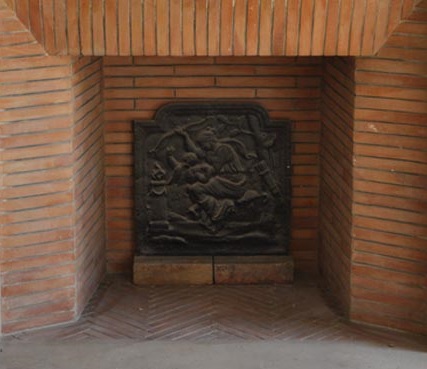
Due to the principle heat source of an open fireplace being the radiant heat, and some of that is reflected and given off by the back of the firebox, and due to the understanding from Desaguliers' experiments that iron emits radiant heat more readily, it became common to place an iron fireback against the back wall of the firebox. Another reason given for this practice is that the fireback protects the rear of the firebox from 'tossing' more firewood onto the fire, but this was important back when soft materials were used in the construction of the firebox and less important now with firebrick and furnace cement are used.