The best location for the chimney is near the center of the building, for when so located its four walls are kept warm; cold winds can not chill it and cause it to draw poorly. -- from USDA Farmer's Bulletin No. 1230, CHIMNEYS & FIREPLACES, December 1921
A chimney located entirely inside a building has better draft because the masonry retains heat longer when protected from cold outside air -- from USDA Farmers' Bulletin No. 1889, FIREPLACES & CHIMNEYS, December 1941
This idea of a cold chimney has the most affect at the startup of a fire and between refueling a fire when the existing fuel has burned down, the burnt fire may still exhaust hot gases but the temperature and quantity of the exhaust gases is less. For some chimneys, a fix for poor draft may be to add height, but if the chimney is located on the perimeter of the house or abutts the structure (is an outside chimney) the fix may not achieve as great an increase in draft that is desired.
Before homes were heated by stoves and furnaces, why were there so many homes constructed with their chimneys located as part of an exterior wall or abut an exterior wall? Thinking back to the colonial era homes, in winter the homes did not retain heat even though they maintained fires, so the indoor temperature was not much warmer than the temperature outside. As a result, in colonial times whether the chimney was interior or on the perimeter of the house would not make a significant difference to the drafting of the chimney, and we see a mix of chimney placements on surviving houses from that era. Building techniques and cost were likely the main drivers as to where to place a chimney during the colonial era; the exception to cost and technique are homes constructed with the architecture in mind.
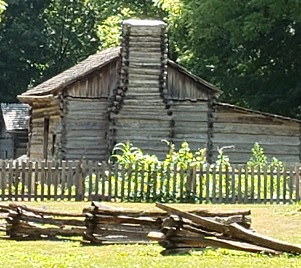
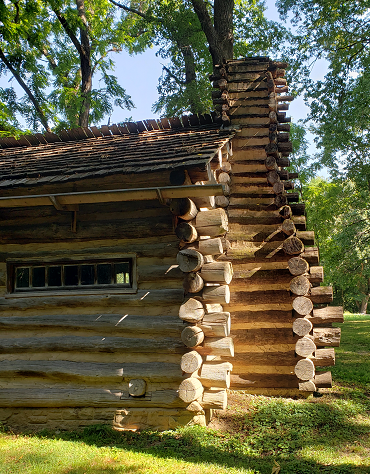
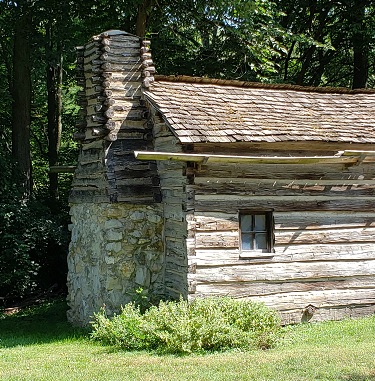
These chimneys are on reproduction frontier homes at the pioneer village of (old) New Salem that is located near Petersburg, Illinois. I have forgotten the name of this type of chimney, I think it is referred to as 'clay and stick' or 'timber and clay' chimney. This town is one of the places that Abraham Lincoln lived for six years. Frontier towns of the 19th century in North America did not have the resources to construct brick chimneys as people in the eastern communities did, that these clay lined chimneys used local resources. It was explained that the top half of the reproduction chimneys are not accurate, as the period chimneys would have been angled away from the house, some so much that they required support posts, but the posts had a function other than to hold up the chimney. Embers often were carried up and out of the chimney and were at a real risk of catching the roof on fire, as the roofing material was usually wood shingles. An angled chimney put distance between it and the structure. Also, chimney fires were a threat, not only from creosote, also that the interior clay lining may fail and expose a timber that makes up the structure of the chimney and catch fire. If the top of the chimney were supported by posts, and the chimney caught fire, the posts could be pulled out to collapse it in an effort to dampen the fire and remove any lit timbers from the structure to prevent the fire from spreading. -- leaning chimneys and especially those with supporting posts were at greater risk of collapse to due to storms and winter freeze and thaws, that the park authorities decided a vertical chimney was safer and less expensive than having to occasionally rebuild them.
These are an example of a functional reason for earlier homes to have their chimneys on the edge of the structure.
Many colonial era homes, in the colonies, that were constructed of brick, also had chimneys on the edge of the structure with the tops of the chimneys leaning away from the house. The purpose of the lean was the same as the frontier chimneys with the exception of any supporting posts and intention to collapse them in case of a chimney fire. For the colonials, the lean put distance of any embers making their way out of the top of the stack from that of the roof that was had combustible material, and in the event of the chimney fire, the upper chimney made of brick likely would survive and probably need reconstructed but the heat would not conduct to the main structure.
Another important factor in draft of a chimney is the volume it can transmit, its sizing, which is one aspect of its design. If a flue is too large for the amount of exhaust gases it is transmitting, outside air can spill down the flue causing turbulence and cool the exhaust gases; if the flue is too small then smoke will fill the room. The sizing of the chimney depends in part on the type of fuel the fireplace burns that it is serving. Both USDA bulletins quoted above provide dimensions, but the 1941 article is more detailed, including adjustments for coal burning in fireplaces. Multi-storied homes often made use of the same chimney to serve a fireplace on different levels using separate flues, to maintain draft on an upper floor that has a shorter flue, the fireplace then needs to be smaller than those on lower levels with taller flues; with corresponding flue cross section sizes.
Poor drafting chimneys, particularly those on the perimeter of the structure that is cooled by the winter air, can be overcome by draft inducers (usually attached to the top of the flue) or stop using the flue for an open fireplace and instead use a furnace or stove especially with an insulated metal reline of the flue. Though at this point on the topic, open fireplaces are still being presented, so continuing with this...
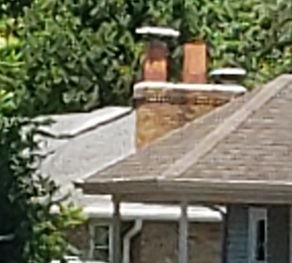
This, probably 1960s, home has a chimney on the perimeter of the house, probably as an attempt to address weak draft, flue tiles were added to the top of the flue to extend the height without incurring the cost of extending the masonry of the chimney. It is not common to see this, however there are a number of these 'fixes' around where I live; this one has been 'fixed' for forty years now. Masonry chimneys as part of a ranch style house in the 1960s and 1970s were often constructed with too short of chimney for the size/ratio of the fireplace to flue cross section to elevation. I suspect home builders had masons skilled in laying brick but not knowledgeable about chimneys, even though being before the internet they probably could have found ratio tables in publications found at many libraries.
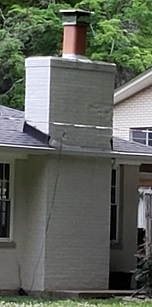
Another example of an extended chimney flue, clearly there is one open fireplace on the perimeter of the house. It can be seen that the single-story house is on a concrete slab foundation with no basement, so it is a relatively short chimney. The elastomeric paint used on the chimney cap runs up the base of the flue tile hiding the joint between the tile extending out of the chimney and the top added tile. I seem to remember the top tile was added in the early 1990s. The elastomeric paint is recent, along with the painted brick.
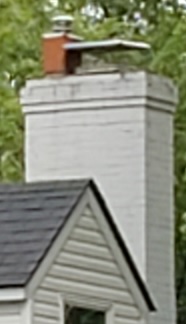
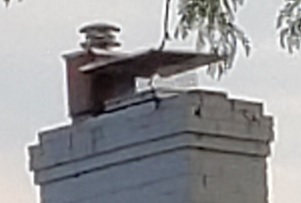
I will try to get a photo that is more clear, these two are the best of what I have taken so far. What is interesting about this flue extension is that when they extended the top tile, they ended up using a tile that is slightly larger than what the chimney was originally constructed with. As far as I know, most of the terra cotta tile manufacturers have continually produced the same proprietary dimensional tiles, so my guess is whoever installed that extension bought the same dimension tile but one that was from a different manufacturer. Its difficult to see but there is a third flue tile fore/right side of the chimney that is nearly level with the chimney cap and has no rain cap of its own.
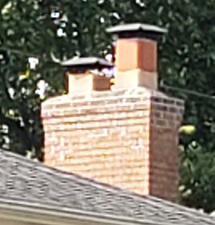
This chimney top is part of a duplex, and the other side has a mirror chimney. The other chimney also has the same height flue tile extension on one of the two tiles in the chimney.
The proper size of flue depends upon the size of the heater or furnace for which it is to be used. All manufacturers' catalogues contain the size of the smoke pipe for each particular heater, and from Table 1 (minimum) dimensions for round, square, and oblong flues may be selected; or if the catalogue contains stack sizes select the proper one. The flue tile to be used should have a transverse net inside area approximately equal to that of the smoke pipe. -- from USDA Farmer's Bulletin No. 1230, CHIMNEYS & FIREPLACES, December 1921 [the following is Table 1 which lists recommended chimney sizes serving an appliance]
| Diameter of smoke pipe or round chimney flue. | Size of chimney flue. | Height of chimney flue above grate. |
|---|---|---|
| Inches. | Inches. | Feet. |
| 8 | 8 by 12 | 35 |
| 9 | 8 by 12 | 35 |
| 10 | 12 by 12 | 35 |
| 11 | 12 by 12 | 40 |
| 12 | 12 by 12 | 40 |
| 13 | 12 by 16 | 40 |
| 14 | 12 by 16 | 45 |
| 15 | 16 by 16 | 45 |
| 16 | 16 by 18 | 45 |
| 17 | 16 by 20 | 50 |
| 18 | 16 by 20 | 55 |
| 19 | 20 by 20 | 55 |
| 20 | 20 by 24 | 60 |
Table of appliance chimneys / furnace flues published in the CARTON Hot Air and Combination FURNACES 1897 Catalogue and Price List, by the Carton Furnace Company, Utica, N.Y. page 43; This table does not fit with examples of tables regarding ratios of open fireplaces, as this table is for air tight furnaces, they do not include elevation or height of flue, even though those parameters are still relevant.
| Total Contents of Building. Cubic Feet of Space. | Tile Flues, Standard Sizes, Square or Rectangular. Outside Dimensions, Inches. | Tile Flues, Standard Sizes, Round. Inside Dimensions, Inches. | Brick Flues. Inside Dimensions, Inches. |
|---|---|---|---|
| 10,000 to 20,000 | 8 1/2 x 8 1/2 | 8 | 8 x 8 |
| 25,000 to 50,000 | 8 1/2 x 13 | 10 | 8 x 12 |
| 60,000 to 100,000 | 13 x 13 | 12 | 12 x 12 |
| 100,000 to 150,000 | 18 x 18 | 16 | 16 x 16 |