As inefficient that open fireplaces were and still are, and setting aside the hominess they impart that many people still value, it should be kept in mind that at least for part of the 19th century, stale air was suspect for causing maladies, and a turn over of interior air with that of outside (fresh) air was considered a benefit; perhaps this was a consideration of indoor air pollutants, and not some derivation of Miasma or Germ theory. The notion that conditioned air in the living space was replaced by cold outside air that then needs conditioned, was not considered the financial and energy waste that it is today, but rather part of the cost of heating. The notion of stale air was not new to 19th century North American or European thinking, but the scientific discoveries during the Enlightenment period may have spurred a sense that it could and should be managed.
The prime function of a chimney is to produce a draft that will cause sufficient combustion and carry off the resulting smoke; incidentally it assists ventilation. -- from the USDA Farmer's Bulletin No. 1230, CHIMNEYS & FIREPLACES, December 1921
Modern wood burning masonry open fireplaces often have glass doors installed over the opening, which if it is a non-modified or modified with outside air ducted on the room side of the doors, then the doors serve to resist the room air from flooding the fire and quickly taking the convective heat up the chimney. The glass door frames are never air tight, therefore and also that even well fitted doors on an open fireplace do not significantly increase its efficiency. The glazing in the doors are a heat resistant ceramic that reflect part of the radiant heat coming from the fire. Therefore, glass doors over an open fireplace are most often used when the fire is burning out, or while the fire is raging but the fire is more for decorative purposes. The doors can be left open for the effect of an open fire.
A modern residential fireplace chimney, one built since the beginning of the AD 19th century, is the structure that contains one or more flues by which the exhaust gases of a fire are directed to the outside. A chimney may have multiple flues within its structure.
Take a look at this example of a multiple story chimney built into the wall of a commercial building, the exterior brick on this building has been removed and exposed the fireplaces and the terra cotta flues -- Google Maps October 2021 images. The building has since been torn down. The ratio of width to height of the fireboxes indicates these were likely coal burning fireplaces, situated in offices at the corner of the building on each floor.
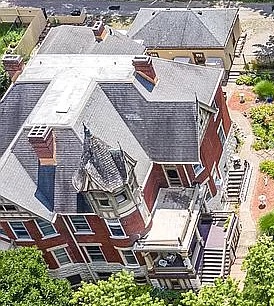
This 1898 duplex, has four chimneys. The county records say the house has two fireplaces. I have not seen this residence for sale, so I have no idea how things are configured inside. The residence has a full basement, two floors, and a walk up attic. The tops of the chimneys, particularly the front chimney with six flues, suggest there may be thimbles in the basement and each floor on both sides, probably intended to serve a furnace or boiler in the basement and parlor stoves at each floor. My guess the county records mean two fireplaces per duplex side, and that the outer chimneys, which appear to have two larger flues each, serve those. The rear chimney with its dual flues probably served a kitchen range for each dwelling.
A chimney can take many shapes, but its purpose of directing exhaust gases to the outside limits its design to be mostly vertical for unpowered types, with straight up being the most efficient. [If you wonder what chimney systems are not vertical, consider the exhaust system of a gasoline or diesel engine in a vehicle, or a furnace in a building that vents horizontally and uses a fan to force the exhaust out.] Modern building codes limit the amount of deviation from true vertical to thirty degrees for solid fuel hearths and appliances. Prior to building codes, many residential chimneys were constructed with jogs, typically in the attic space, but the functional impacts to the draft of a chimney serving solid fuel fires resulted in few chimneys exceeding a thirty degree jog. Some chimneys that were constructed with a jog traveled enough that the builders braced the jogging portion in the attic space, the bracing was typically supported by the nearest roof rafters. At the beginning of the 20th century, tables in publications can be found for various dimensions of fireplace to flue cross-section to chimney height to elevation above sea level, so that a planned fireplace can draft and exhaust the smoke appropriately.
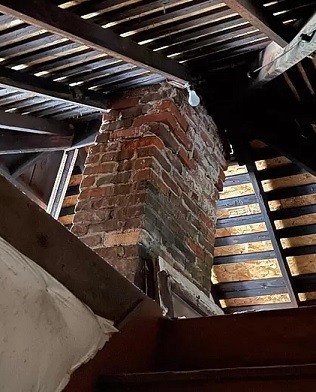
This 1917 house has a chimney that jogs in the attic space.
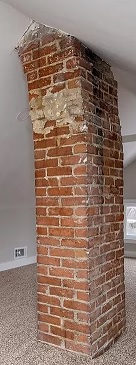
Lost track of which house this photo is taken from.
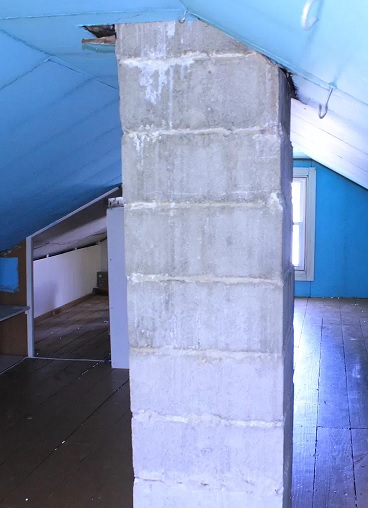
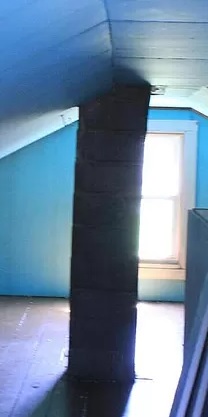
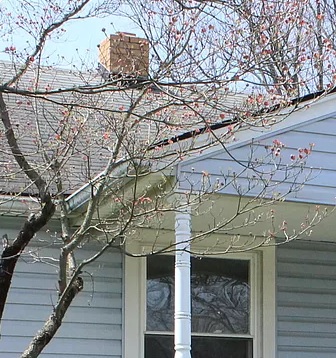
This 1949 house, the appliance chimney passes up into the attic and jogs (views from opposite sides) to exit close to the center of the roof peak. Note the structure of the chimney is cement block, and faced with brick above the roof.
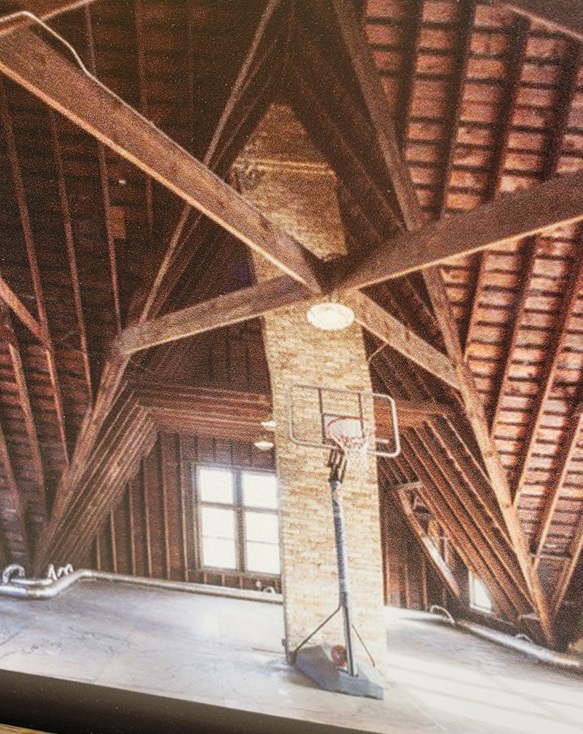
This is a photo of a photo. While touring a Victorian house that had been updated, the pictured chimney in the attic jogs midway up to the left and away. Although the tour restrictions included no photos inside, there were a few before and after photos setup outside, this is of a before photo of the attic. From the angle, the jog away from the vantage point cannot be seen, but it is just as far away as it jogs to the left.
Though not common, there exist a number of houses from the late 19th and early 20th centuries that had separate fireplaces, where the tops of the chimneys were brought together in the attic before breaching the roof, so that from the outside there appeared to be only one chimney.
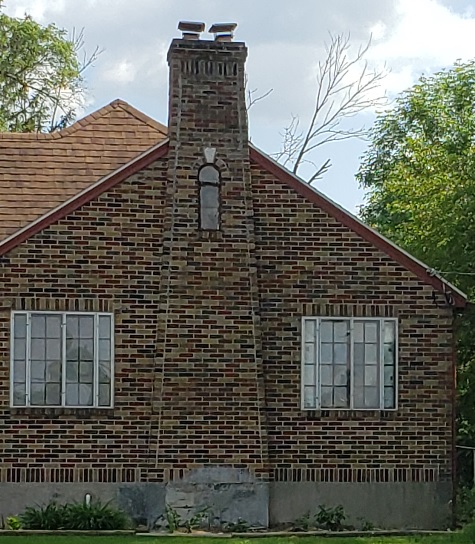
This chimney that is on the external edge of the home's living space has a window built in between the flues of the chimney for the second floor attic space.