The greatest defect in the construction of dwelling houses, public buildings and manufactories, is observable in the means of warming and ventilating them. Notwithstanding the boasted comforts of an Englishman's fire-side, we see it accompanied with evils, which loudly call for remedy. The common construction of fire places, and the means of admitting air into the rooms, is quite sufficient to convince us that these principles have never been investigated in a philosophical point of view.
When a house is built, a tunnel is made from each room, for the escape of smoke and vapour, the greatest part of which ought to be consumed. This is also a channel for the escape of the air of the room, which cannot be replaced, but by the cold air from the atmosphere; for the entrance of which no provision is made, except by the accidental crevices formed by the shrinking of the wood, forming the doors and windows.
The evils resulting from these defects are, first, those sitting before a good fire are scorched on one side, and chilled by the cold air on the other; secondly, the cold air entering the chimney without passing through the fire destroys its draught, and renders the combustion of the fuel so imperfect, that a considerable portion passes away unburned, or comes into the room in the form of smoke, producing the greatest of domestic evils. That which goes out of the top of the chimney, annoys the neighbourhood. And that which adheres to its sides, would soon entirely stop the chimney funnel, if not removed by means, in the greatest degree degrading to human nature.
None of these evils need now exist, especially in houses yet to be erected. The combustion of coal may be now rendered complete, not producing the least smoke, and at the same time avoiding the nuisance of ashes from the grate.
Instead of the annoyance of cold air, which comes into the rooms by the doors and windows, a current of warm air at any desired temperature, may be made to escape at the same aperture in a contrary direction. The air which supplies the room, should enter at the ceiling over the fire place. This air, in winter, should first be warmed by passing along a culvert underground, and the additional heat given to it by a stove which we shall hereafter describe. In summer the air may either be admitted immediately from the atmosphere through the same passages, or underground when the weather is very hot.
-- from The Philosophy of Domestic Economy; As Exemplified In The Mode Of Warming, Ventilating, Washing, Drying, & Cooking, And In Various Arrangements Contributing To The Comfort And Convenience Of Domestic Life | by Charles Sylvester, Engineer | 1819 | page 8-10
In the late 19th century, interest at improving the efficiency of open fireplaces resulted in many designs. These improvements have become known as "modified" fireplaces. Modified fireplaces could be constructed for any type of fuel (gas, wood, coal, oil, et cetera). The modifications were usually in the form of two features; one of the feature types were separate ducts low in the chimney that permitted room air to pass behind or along the sides of the firebox to be heated and returned to the same or different room without mingling with the fire.
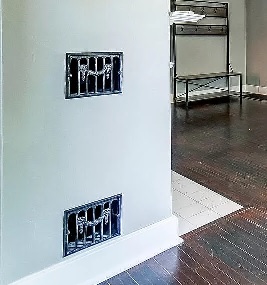
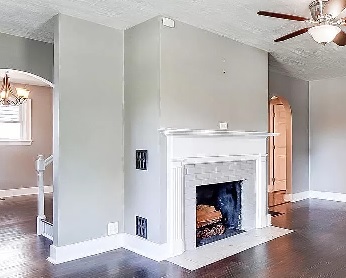
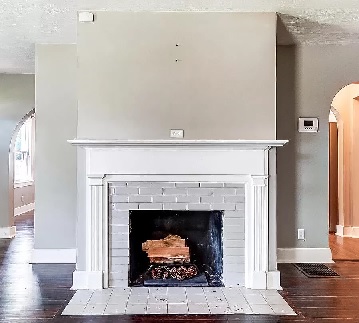
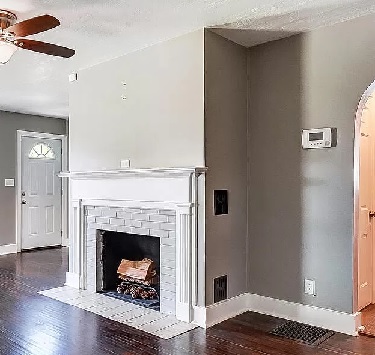
This 1936 home has a masonry modified open fireplace, the 'modified' feature that allows room air to enter the lower register, get heated by the back and sides of the firebox, and then return to the room through the top register. This chimney and fireplace also are interior to the floorplan of the house.
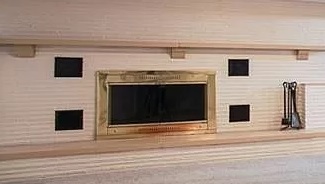
This modified basement fireplace in a 1957 house allows room air in the lower registers and return to the room out of the upper registers. Interestingly the main floor fireplace had no modified features. The photo is not stretched, the masonry wall was long, and the fireplace opening is comparatively wide.
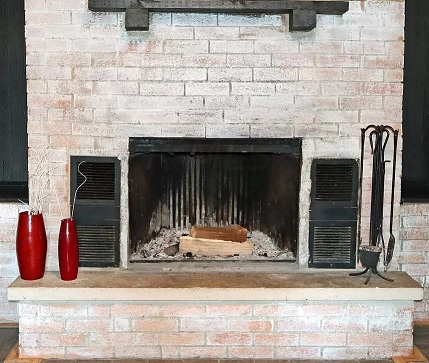
The registers on this fireplace have a short channel to pass through. If you were to take off either side registers you would see one large void behind each register. It is the metal of the register, those cut slits along the top and bottom with a solid piece in the center that tranforms these two side voids into channels. The two side voids are separated from the firebox by the masonry of the firebox.
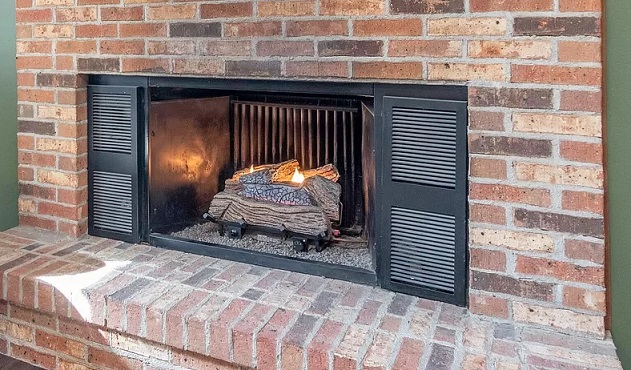
The masonry of this fireplace has no inherent modified feature. The firebox is constructed out of metal, and sets inside the void of the masonry chimney where a masonry firebox would otherwise be, and as part of its metal construction the side voids are included, registers are used to cover over the side voids. The channels of the side voids are a result of the solid center of the registers.
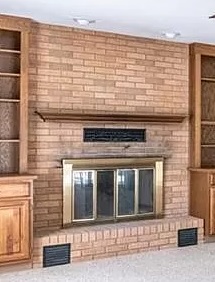
This type of modified fireplace allows room air in from two lower side ducts, and returns back to the room centrally above the firebox.
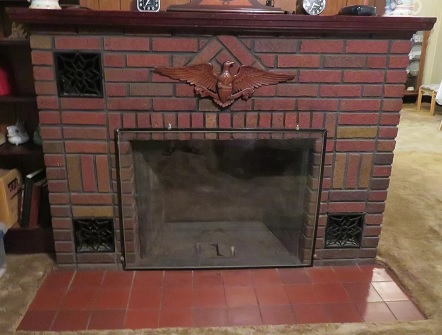
The upper right register opens up to the side of the fireplace, so only three of the registers are on the face.
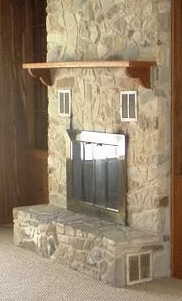
The image shows lower side intake registers, and upper face vent registers.
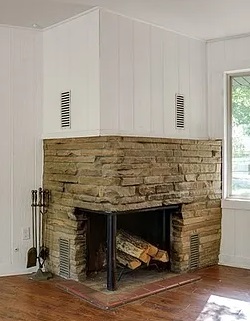
The image shows a corner two sided fireplace with registers on each side.
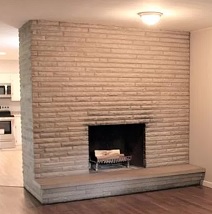
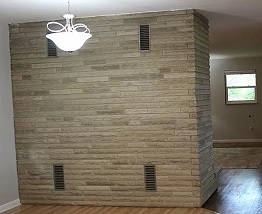
The vents for the modified feature on this open fireplace are on the backside.