The other "modified" open fireplace feature type was a ducted path for outside air to be routed directly to the front of the hearth. By providing a ducted path for outside air to reach the fire, the draw of the fire no longer pulls air into the living space from outside through gaps in the building (door, windows, framing), causing the room air to stay warmer longer. A number of designs appear in advertisements and catalogs, which (over decades) illustrate a trend of longer ducts further from the hearth. The USDA Farmer's Bulletin No. 1230 conveniently illustrates the idea with example drawings.
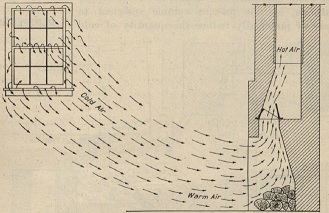
This USDA Farmer's Bulletin drawing illustrates an open fireplace that has no modified features, and is burning firewood. The heated air that goes up the chimney causes a depresurrization of the room that draws in outside air. The makeup air is being pulled inside from around gaps in the residential structure.
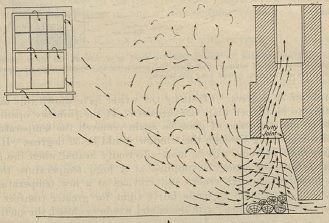
This USDA Farmer's Bulletin drawing illustrates a duct to admit outside air to the back of the fireplace. When the fireplace is constructed, a metal baffle is formed around the interior of the masonry firebox, and the ducted outside air is forced around the backside of the baffle. The fire heats the baffle from the front, and the outside air is preheated by the backside of the baffle. The duct for the outside air should have a door over it on the outside of the house so that the duct can be closed off when there is no fire in the fireplace.
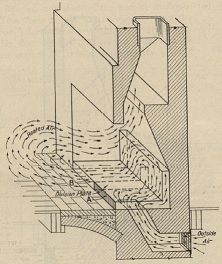
This USDA Farmer's Bulletin drawing illustrates that rather than using a baffle, the duct is extended into the firebox. Various designs were offered for where the duct ran within the firebox, and how long the duct ran within the firebox, and where the duct terminated in front of the fire. The duct within the firebox could be metal or some form of masonry.
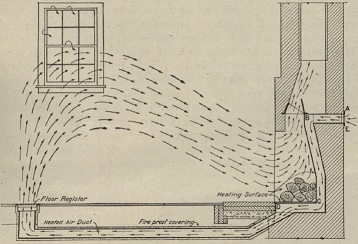
This USDA Farmer's Bulletin drawing illustrates passing the outside air along the backside of the firebox and then ducting it into the room farther away from the fireplace. As it is illustrated, someone sitting or standing in front of the fire would feel a movement of air to the fireplace from the room from the general direction of the vent. This may seem like a negative, but with this configuration the room is receiving radiant energy from the fire as well as preheated makeup/outside air mixing with the room air, making the inside temperature more evenly warmed.
The feature of supplying combustion air to the fire through a duct from the outside can be accomplished in other ways. This can and was accomplished with older open fireplaces for solid fuels like firewood and coal by ducting the combustion air from lower levels of the house (usually the basement) instead of from outside, or if the chimney is within the floorplan drawing from the room behind the fireplace and on the same floor level. A caveat exists for this setup, which is due to fluid dynamics, that for an open fireplace the depresurrization draws from the closest sources, so if the duct is too long or the air comes from the basement but the basement is relatively air tight, then a greater portion of makeup air will be drawn in from cracks in the building envelope closest to the fireplace. Many masonry open fireplaces were constructed with ash pits. In the firebox with an ashpit, a flap or set of flaps are built into the floor, and at the bottom of the ash pit an access door can be used for clean out. It has worked out that even on fireplaces without an outside air duct, the ash pit feature can be treated as a substitute. If the flap(s) in the firebox and the ash pit door are left open, and the ash pit is not full of ash, these can allow air to be directed to the fire, albeit not preheated like the dedicated ducted combustion air would be.
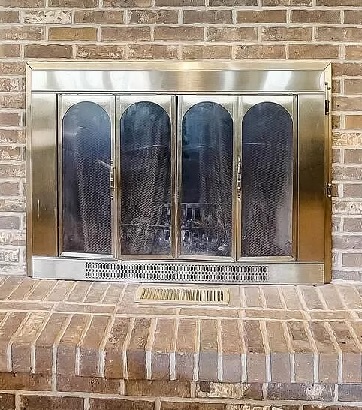
This 1986 home has a masonry fireplace and chimney; notice the HVAC register in the brick hearth directly in front of the center of the glass screen doors. This could be an example of a duct for outside air to the front of the fireplace. I was not able to confirm this one, but this is the typical setup for a modern outside air duct to the firebox; decades before some sort of iron flap was common. If a chimney were on the edge of the structure, the ash pit door at the center of the hearth/firebox could sometimes serve as a cold air inlet if the firewood was supported by a grate. Ducts were sometimes constructed within the firebox, but close to the front of the hearth, which iron flaps held up better in the presence of the fire, and depending on the configuration also served a double duty of being the ash pit sweep door.
Tests conducted by this Bureau indicate that, as ordinarily constructed, a fireplace is only about one-third as efficient as a good stove or circulator heater. Nevertheless, they have a place as an auxiliary to the heating plant and for their cheerfulness and charm. -- from the USDA Farmers' Bulletin No. 1889, FIREPLACES & CHIMNEYS, December 1941
The disadvantages of the ordinary fireplace are lessened by "modified" fireplaces. -- from the USDA Farmers' Bulletin No. 1889, FIREPLACES & CHIMNEYS, December 1941
However, the nature of operation [of "modified" fireplaces], with the unavoidably large quantity of heated air passing up the stack, makes the inherent over-all efficiency of any fireplace relatively low. Therefore, claims for an increased efficiency of modified fireplaces should be understood merely as constituting an improvement over the ordinary fireplace and not over stoves or central heating plants. -- from the USDA Farmers' Bulletin No. 1889, FIREPLACES & CHIMNEYS, December 1941