Around AD 1740, Benjamin Franklin invented an iron fireplace he named the "Pennsylvania fireplace". He declined to patent it, which resulted in many variations that nearly always did away with the rear baffle in Franklin's design, these are often referred to as Franklin stoves. Supposedly part of Franklin's inspiration came from Jean (John) Theophilus Desaguliers' experiments, which is said to show that iron is more effective than masonry for heating. Wikipedia has a decent webpage about these, along with a photo of an early model backed into a masonry fireplace, here. Another example of a Franklin stove backed into a fireplace can be found here.
The Franklin stove is a type of modified fireplace. -- from the USDA Farmers' Bulletin No. 1889, FIREPLACES & CHIMNEYS, December 1941
Contemporary usage of the word stove tends to refer to an appliance that attempts to control the amount of incoming air to the fire, therefore a Franklin stove may better be described as a metal open fireplace. There were, however, Franklin stoves that were sold with separate covers, that when the cover was set in place it caused the metal fireplace to essentially be the same as a stove. Later variations had metal doors hung from the sides of the opening, so while shut they covered over the opening causing the metal fireplace to essentially function more like a stove. Users of Franklin stoves often use them like masonry open fireplaces, only applying the cover or closing the integrated doors once the fire has burned down and wanting to let it burn out but keep the room air from escaping up the chimney. Franklin style stoves with covers or integrated doors do well to damper off the room air from the firebox, but are not considered air tight.
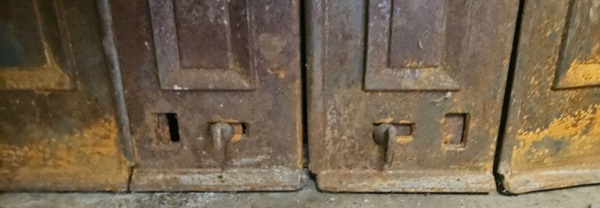
On this Franklin from the mid-20th century with folding doors, the center door panels have air control slides to be able to admit combustion air while the doors are closed.
Many 19th century cast iron stoves are described as being in the style of a "Franklin stove". The Franklin style generally are freestanding, short in comparison to parlor stoves, and the exhaust port exits horizontally in order for the stove pipe to clear the lentel of an open fireplace and dump exhaust gases to the flue of the fireplace. Many 20th century homes were built without fireplaces, and sometimes without appliance chimneys; the homeowner would opt for a contemporary Franklin fireplace that was built with a vertical exhaust port, and using stove pipe exhaust to an appliance chimney at the thimble, or run the stove pipe through the ceiling and roof and it be a metal chimney with flashing.